

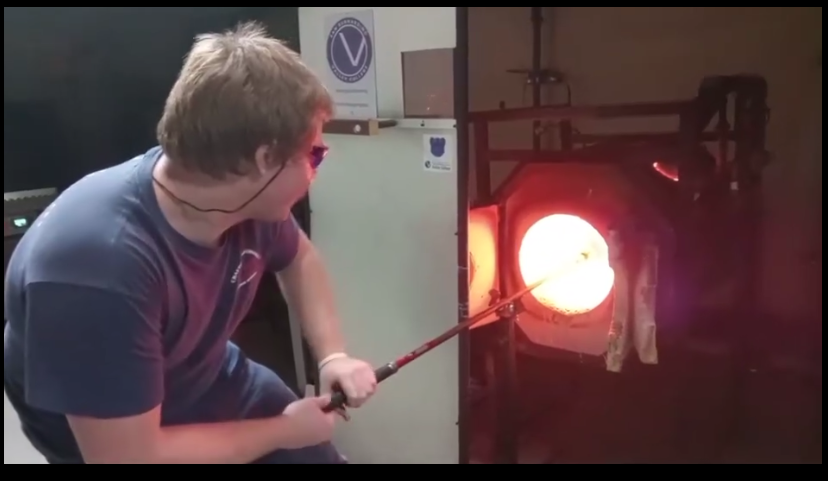
Few art forms require equal parts creativity, precision, and fire. For Austin Young, glassblowing checked every box. After spending his childhood helping his dad on construction jobs and making art with his grandmother, he discovered a craft that brought those worlds together.
“It was a way to work with my hands and be creative,” he says. “I also got to use industrial equipment, which I really enjoyed.”
That discovery led him to San Bernardino Valley College (SBVC), home to one of California’s only four community college glassblowing programs. This glass-forming technique involves inflating molten glass into a bubble with the aid of a blowpipe (or blow tube).
SBVC recently launched a new Certificate of Achievement in Artistic Glass and Design. As of Fall 2026, a record 50 students have enrolled in these courses.
“I really enjoyed learning how to make both functional and sculptural pieces,” Austin says. “I learned many different vessel-blowing techniques which I have used to make functional pieces like cups, vases, and lighting.”
The program offers beginning to advanced-level courses, covering a wide range of skills. The Artistic Glass and Design Certificate provides students with a hands-on, comprehensive education in glassmaking, equipping them with the technical and creative skills necessary to enter the art glass industry, a sector focusing on glass objects made for their beauty, design, and artistic expression rather than pure industrial utility. The industry encompasses high-end glass sculptures, custom architectural installations, home decor items, and handmade consumer goods.
“Students make a really broad range of work,” says SBVC art professor Timothy Colbert, who leads the glassblowing program. “In Beginning Glassblowing, much of the emphasis is on learning to control the material, so students begin with fundamental forms and gradually work toward pieces such as cups, bowls, cylinders, bottles, and other functional or sculptural forms.
“As students move into the intermediate and advanced levels, those fundamental skills become building blocks for much more complicated work. They begin combining forms, working with color and pattern, creating larger and more complex pieces, and developing projects that require considerably more planning and technical control,” he says. “By the advanced level, I’m much less interested in telling a student exactly what object they should make. I want them to begin developing their own ideas and creating a body of work that reflects their individual interests as an artist.”
Students learn the craft in top-notch facilities, including a recently upgraded glassblowing hot shop, a dedicated glass design studio, glass fusing and kiln-forming capabilities, and a coldworking facility where students can cut, grind, polish, and finish their work.
“For me, the most exceptional part is that all of this exists at a community college,” Colbert says. “Students don’t have to attend a private art school or an expensive specialized program to gain access to these processes. They can come to SBVC and have the opportunity to work in a sophisticated glass facility as part of an affordable community college education.”
Students need not travel far if they wish to continue refining and extending their skills. Students can come to SBVC with no previous experience, progress through the courses, and then transfer to Cal State San Bernardino (CSUSB) to continue studying glass and go on to earn a master’s of fine arts.
“What’s remarkable is that they can make that entire educational journey within about an eight-mile radius,” Colbert says. “Having this pathway available right here in the Inland Empire gives our students an opportunity that doesn’t exist in many communities.”
These skills become part of a broader career in art and design for some students, and for others, they become the foundation for continuing their education and developing a much more specialized area of expertise, he says.
Many of Colbert’s students have continued their glassblowing education at CSUSB or gone on to develop their own artwork as part of a studio practice or business. Others pursue careers as full-time professional glassblowers, working as production glassblowers in commercial settings, studio assistants, glass artists, or fabricators producing functional objects. Job opportunities can be found with established glass studios, educational programs, museums, and organizations that work with glass.
Austin wants to use the vessel-making skills he learned at SBVC to make functional pieces, like lighting and glassware. He’d like to use the sculpting techniques he learned to continue making glass art. He received a scholarship to continue his education at the Pilchuk Glass School in Washington state and then moved to Seattle, where he now works as a glassblower for an antique glass producer.
“I would never have had these opportunities if I hadn’t taken the courses at SBVC,” he says. “I plan to continue to learn skills on the job and hope to one day be a full-time glass artist able to make my own work as a career.”
Austin is dreaming up some fruitful concepts for the future.
“Right now, I have an interest in making glass oranges. I am also interested in making large-scale structural glass pieces and art installations. I would love to one day make a full-scale glass orange tree,” he says.