

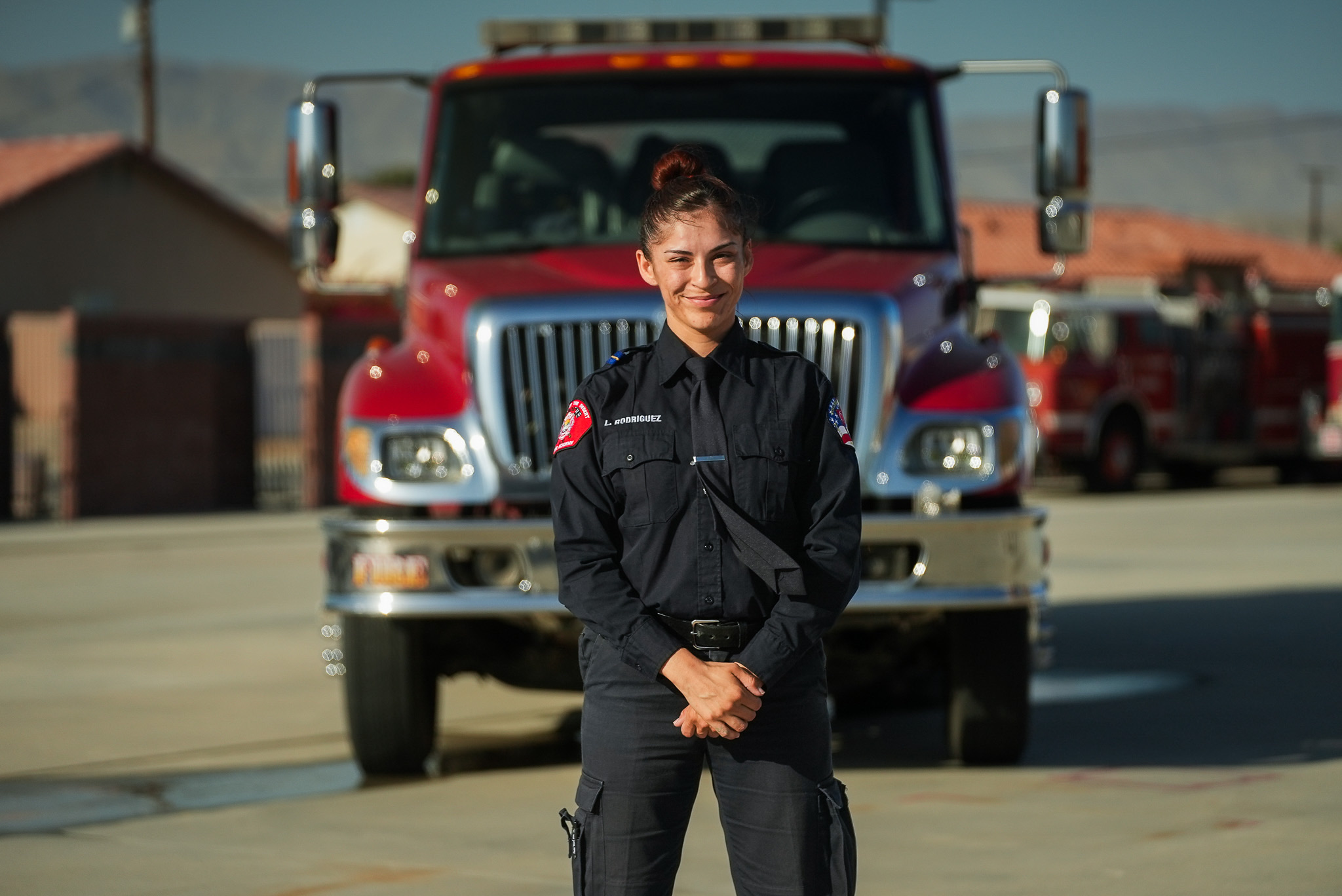
As a single mom, Leslie Rodriguez worked long hours at multiple jobs – from pool cleaner to waitress to post office clerk – to support her young daughter.
“I worked an average of 60 hours a week, always exhausted, wanting to spend more time with my daughter. I felt a drive that I wanted more of life,” she says. She asked her coworkers at the Palm Desert Post Office what colleges were nearby and learned about College of the Desert (COD), researching the college’s academic programs to see what grabbed her attention. “I went back to the emergency services section and read through everything, including the prerequisites for the Basic Firefighter Academy.”
Rodriguez was looking for something deeper in her career. “I loved helping people but wanted more meaning, and I enjoyed the medical aspect of things,” she says. She needed to complete and pass Emergency Medical Technician training to qualify for the fire academy. When she rode out for her first ambulance shift, she felt “a switch in her heart.” Being there for people in their most dire moments of need was what she wanted to do.
Rodriguez was accepted into the Basic Firefighter Academy (BFFA) at College of the Desert (COD), where she graduated with an outstanding cadet award and the basic certifications required to become an entry-level firefighter.
She joins hundreds who have graduated from the College of the Desert Basic Fire Fighter Academy (BFFA). Since 2013, the Academy has given cadets rigorous basic training to launch their careers as firefighters, fire engineers, paramedics, forest service workers, health and safety officers, fire prevention specialists, fire inspectors, fire investigators, fire protection engineers, and hazardous materials specialists.
Upon graduation from the Basic Fire Fighter Academy (BFFA), cadets earn the California State Fire Training (SFT) Fire Fighter 1 certification and complete all training requirements needed to pursue the SFT Fire Fighter 2 certification. The Fire Fighter 1 certification is recognized throughout California and the United States as meeting the foundational firefighter training requirements for entry-level employment within the fire service. The Fire Fighter 2 certification must be initiated and completed through employment with a fire agency.
The certificate provides individuals with the knowledge and skills to safely perform, under minimal supervision, essential and advanced fire ground tasks. These include basic rescue operations, auto extrication, basic fire suppression, prevention and investigation, a basic knowledge of the Incident Command System (ICS), and an introduction to the potential dangers of hazardous materials. In addition, students will learn to use, inspect, and maintain various types of firefighting and rescue equipment.
The COD BFFA is unique as it is one of the few fire academies offering a part-time format.
“Our flexible schedule provides greater accessibility to individuals pursuing a career in the fire service without sacrificing the training quality or rigor of the program,” says COD Fire Academy Coordinator R. Pete Tierney.
The Academy meets Wednesdays, Thursdays, and Fridays during the Fall and Spring semesters. Most other academies are full-time and require cadets to attend Monday through Friday for about 16 consecutive weeks.
Cadets in the COD program can also earn additional California State Fire Training (SFT) certifications beyond the minimum requirements for Fire Fighter 1 and Fire Fighter 2. Additional certifications offered include Firefighter Safety and Survival and Rapid Intervention Crew (RIC) training.
“These supplemental certifications are highly desirable to fire service employers because they provide graduates with advanced knowledge and skills that enhance firefighter safety and operational effectiveness,” Tierney says. Associate degrees in Fire Technology and Certificates of Achievement in Fire Technology and Public Safety are also offered.
The COD Basic Firefighter Academy is conducted at the Roy Wilson Training Center in Thousand Palms, operated through a mutual partnership with CAL FIRE/Riverside County Fire. The training grounds feature a variety of hands-on training props, a four-story drill tower, and four college-owned fire engines that provide cadets with realistic training experiences throughout the academy. Cadets complete extensive practical training in hazardous materials operations, structural firefighting, wildland firefighting, rope rescue, and vehicle extrication.
A cadre of active and retired firefighters from fire agencies throughout Southern California provides instruction. “They bring real-world experience to the classroom and drill grounds while ensuring all training meets California State Fire Training (SFT) standards,” Tierney says.
Rodriguez, who was the first woman ever chosen as the Academy’s class duty officer, a key cadet leadership position, says a highlight for her was drawing on the experience of the instructors and special guests from all around the state, including fire chiefs, captains, firefighters, dispatchers, and others.
“They explain what it’s like on a day-to-day basis, the expectations, and traditions,” she says. “They are there 100% to help, and you can tell they have the mindset of ‘Service over self.’”
The Academy’s extensive partnerships with area fire agencies provide many of its instructors and guest speakers, as well as many of its students, who have been recruited by local fire agencies and sent to the Academy for training. An advisory committee featuring leaders from CAL FIRE/Riverside County Fire, Palm Springs, Cathedral City, Morongo, and Calimesa Fire Departments helps guide the Fire Technology curriculum to ensure it meets the exact operational needs of local fire services.
Rodriguez is currently a reserve firefighter for the County of Riverside in the Coachella Valley area and also assists BFFA instructors. She plans to pursue her Fire Science & Technology associate’s degree and then a bachelor’s degree in Fire Leadership and Administration. In the meantime, she’s applying to work as a full-time career firefighter in Southern California.
According to Tierney, the Inland Empire is expected to see a 13% increase in demand for firefighters from 2025-2030, with 307 positions opening annually. California employs more firefighters than any other state, with about 31,470 currently employed statewide (Career Explorer). Nationwide, firefighting jobs are expected to rise 4% between 2025 and 2035 (bls.gov).
With her new career, Rodriguez is thankful she has a little more time to spend with her daughter.
“With this career, I get to give her little surprises or take her out on spontaneous day trips without worrying if I still have enough money to pay the bills.”
And daughter is very proud of mom.
“She has expressed loudly to her teachers and friends, ‘My mommy’s a firefighter!’ She plays dress-up with a princess dress, a captain’s helmet, and a stethoscope around her neck. On occasion, while I’m lying down resting, she’ll initiate CPR. So, I can say with confidence that she’s proud of me just as much as I’m proud of her.”
In the end, Rodriguez feels a strong sense of meaning and fulfillment in her new career.
“Firefighting isn’t just brute force in fighting fires; it’s about patient care, life over property, connecting with your community, and being there for one another. I look forward to one day being given the opportunity to instruct future firefighters and be their role model the same way I looked up to the cadre when I attended my fire academy.”