

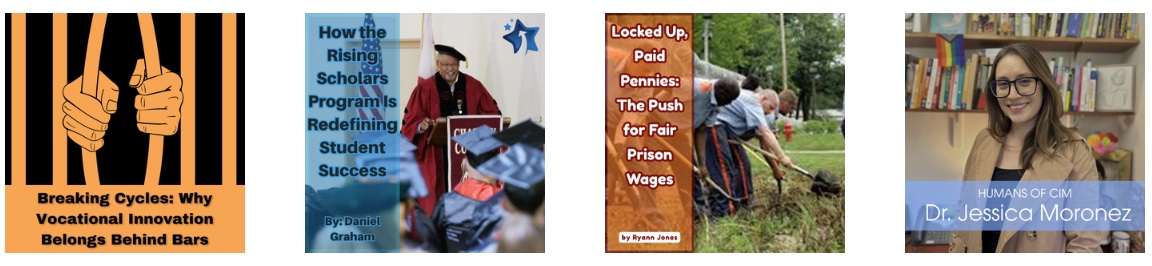
Many community colleges have a journalism program, but few teach it from within prison walls. This past summer, Chaffey College launched a journalism degree program inside the California Institution for Men (CIM) in Chino, creating perhaps the only such community college program for incarcerated men in the country.
“I want to make my family proud – my wife, my kids, my mom, myself,” says Chaffey CIM journalism student Ryann Jones, who says he enrolled for the challenge, to broaden his horizons, and become a better writer.
Student James Cummins says he was drawn to the program by his love of writing, which he wants to build on for his future.
“There may be opportunities, career opportunities, outside of these prison walls for me, and with a journalism degree, my chances at thriving increase,” he says. “This could be my calling, and if I fail to jump on the opportunity, I may miss it.”
Students in this Associate of Arts for Transfer (AA-T) program learn journalism practice and theory, English, photography, computer skills, and study communications.
According to Chaffey journalism professor Ian Jones, the curriculum offered inside the prison is very similar to the regular program with a few modifications.
“Limited access to the internet inside means some work is different — there is more ‘pen-and-paper’ learning in class, for example — but the material covered is the same. For our multimedia course, we are focusing exclusively on audio storytelling (as opposed to video and social media storytelling that we teach on the outside) as there are some restrictions about how and when you can record inside a prison that we are still exploring.”
Jones says they are setting up two recording booths and equipping student computers with audio mixing software — the same state-of-the-industry gear that Chaffey’s non-incarcerated students use.
“The wonderful thing about journalism is that students get to work on more ‘academic’ skills such as writing and media literacy in very pragmatic ways that are more ‘career’ focused. They report and write stories and then lay them out using Adobe software, or they record and mix them using Audacity and other audio applications,” Jones says.
Since CIM students are not allowed to access the internet, journalism students on Chaffey’s Rancho Cucamonga campus who work on the newspaper, The Breeze, provide support with research, data collection, and digital publishing.
Lionel Getten, who recently served as editor-in-chief for The Breeze, said he is excited the newspaper will get to collaborate with CIM writers, and help them get job skills to succeed.
“I can only hope that our program sets the standard of journalism’s goal, which is to provide accurate and trustworthy information from an equitable perspective,” Getten said. “After all, what’s more equitable than giving an overlooked demographic the opportunity to thrive?”
Chaffey College has been teaching inside Chino Institution for Men since 2006, but the journalism program is perhaps the first of its kind among community colleges.
“We did some research, and we could find no record of another community college prison journalism program. There are 4-year colleges doing this, but no other CCs, we think,” Jones says.
Journalism is a great program to offer inside. Some fields bar formerly incarcerated people from employment, but journalism imposes no such restrictions. It is also fairly inexpensive to teach since it does not require expensive equipment and dedicated space.
According to Jones, the new journalism program has garnered strong Interest with 50 students signing up when they only planned for 25. It is part of a longstanding and successful initiative to bring high-quality education to incarcerated people at both CIM and the California Institution for Women (CIW). The program, called Rising Scholars, promotes Chaffey’s vision to transform the lives of currently incarcerated students through education. The program has served nearly 1,000 students since 2004, with students passing 94 percent of courses they have attempted and often continuing their education at other community colleges, or four-year universities like UC Berkeley and San Diego State.
“Thus far, I have enjoyed the knowledge learned. The professionalism of the professors and their acceptance of me as a human being, and not (a criminal), is so valuable to my rehabilitation,” says CIM student Cummins. “Rising Scholars students get treated no different than others, and we are held to the same high scholarly standards.”
Many of the students in the new journalism program will continue on for a bachelor’s degree at Cal State Los Angeles. CSULA prefers students who have already completed an AA-T with Chaffey because they have the skills to then succeed in the CSU program.
Local news partners have already started picking up stories from CIM students. Local News Pasadena has published the first in a new series of articles in the works. Articles are also published in The Breeze.
Plans for the future include launching a prison paper and podcast network in Fall 2026.
“This will give students a venue to tell the stories that matter to their community,” says Jones. “There are already people in CIM producing newsletters and podcasts — this program will provide them the skills to create more polished products.”
The journalism program is currently only offered in one part of the prison, but there is interest to expand the program to other parts of CIM and to CIW.
Cummins sees an opportunity to make an impact through journalism.
“If I can make a positive difference in today’s society, whether it be faith-based, carceral, beat (a specialized area of reporting), or investigative, it would make me feel like I actually accomplished something meaningful in my life and have made some sort of amends for the harms I have committed — my new purpose in life.”